
Types of Mobile Apps: Native vs Hybrid vs Cross Platform
A Decision That Shapes More Than You Might Expect
When businesses begin planning a mobile product, attention naturally goes to features. What will the app do? What will users see? These are important questions, but there is an earlier decision that quietly shapes every answer that follows: the type of app you choose to build.
Native, hybrid, or cross-platform. Each approach carries its own implications for cost, performance, timeline, and how the product scales over time. Choosing the right one early in the mobile app development process can prevent significant rework later and give the product a more stable foundation from the start.
The Three Main Types of Mobile Apps
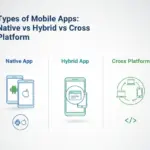
Before examining each approach in detail, it helps to understand them at a foundational level.
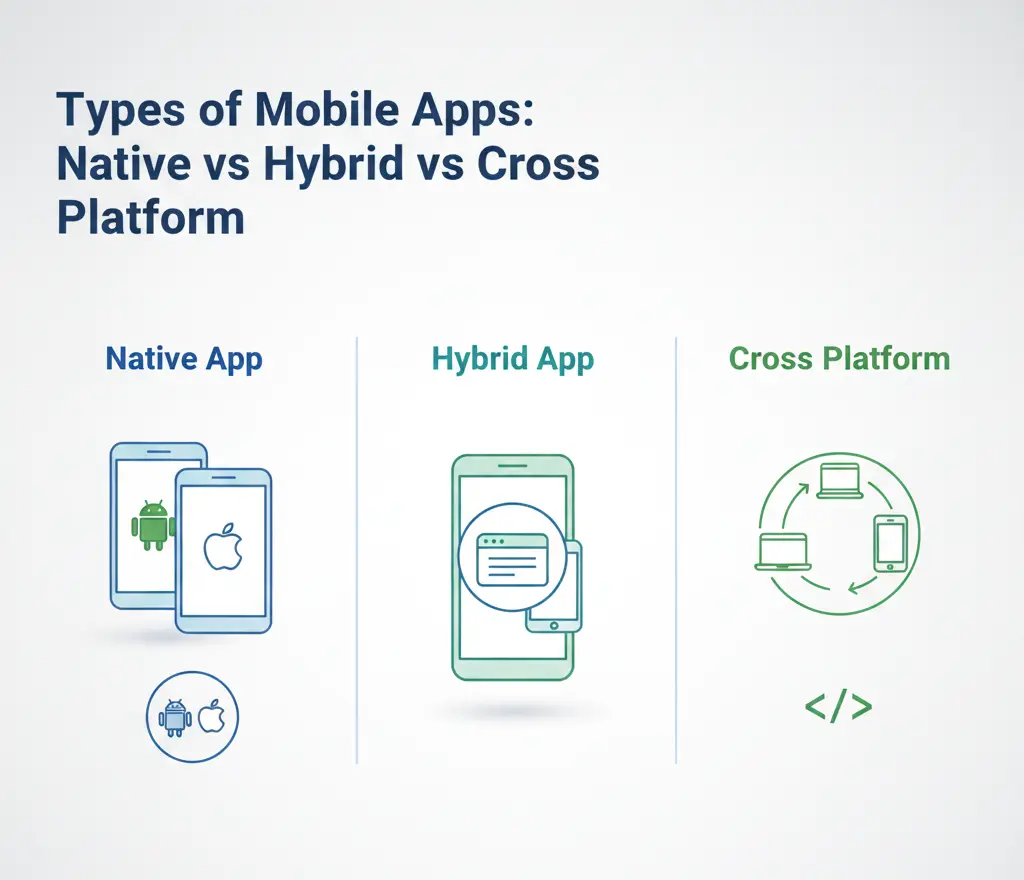
- Native apps are built specifically for a single platform, either Android or iOS, using the tools and standards of that platform.
- Hybrid apps are built with web technologies and packaged into a mobile container that allows them to run as an app on a device.
- Cross-platform apps use a single shared codebase that is designed to run efficiently across both Android and iOS.
All three approaches are used in mobile application development today. The differences lie in how they are built, how they perform under real usage conditions, and what trade-offs each one asks you to accept.
Native Apps: Built for Performance and Full Control
A native application is developed specifically for one platform. It is built using the development standards of that platform, which means the app is fully optimised for the environment it runs in. Every element of the interface, every interaction, and every hardware call is handled in a way that is native to the device.
The app is built to operate exactly as the platform intends, which means the interface, interactions, and hardware communication all function at the level the device was designed to support. The result is the highest level of performance available in mobile development. Animations are smooth, interactions are responsive, and the app behaves consistently with the user’s expectations for that platform. Native apps also have unrestricted access to device hardware, including the camera, GPS, sensors, and any platform-specific capabilities.
Where Native Development Works Best
- High-performance requirements: Applications that depend on real-time processing, complex animations, or intensive user interaction benefit most from native development.
- Frequent and habitual use: When users are expected to return to the app regularly, the quality of the experience matters significantly, and native delivers the highest standard.
- Feature-rich platforms: Products with complex functionality that needs deep integration with device capabilities are well-served by a native approach.
Key Considerations
- Separate development for each platform: A native Android app and a native iOS app are built and maintained independently, which increases both cost and development time.
- Higher investment: Native development typically requires more resource than hybrid or cross-platform approaches.
- Longer build timelines: The additional complexity of building and maintaining separate codebases extends the time required to reach the market.
For businesses with a clear long-term product vision and a requirement for the highest level of user experience, native development remains a strong and well-justified investment.
Hybrid Apps: Speed to Market With Acknowledged Trade-offs
Hybrid apps are built using web-based technologies such as HTML, CSS, and JavaScript, then packaged inside a mobile container that allows them to be installed and run like a traditional app. Because a single codebase serves both platforms, hybrid development is typically faster and less expensive than building natively.
For teams with web development experience, hybrid apps reduce the learning curve involved in entering mobile app development. The build cycle is shorter, and the cost of getting to market is lower.
The trade-off is performance. Hybrid apps run through a web layer, which introduces latency that becomes more noticeable in applications with complex interactions or visually demanding interfaces. Access to device hardware typically requires additional plugins, which can introduce inconsistencies in behaviour.
Where Hybrid Development Works Best
- Simple or early-stage products: When the primary goal is to get something functional in front of users quickly, hybrid development delivers that outcome efficiently.
- Budget-constrained projects: The lower cost of a shared codebase makes hybrid a practical option when resources are limited.
- Fast launch requirements: When time to market is the overriding priority, hybrid development can significantly compress the timeline.
Key Considerations
- Performance limitations: The web layer introduces overhead that affects smoothness and responsiveness, particularly in complex or interaction-heavy applications.
- Plugin dependency: Device feature access often relies on third-party plugins that may not always behave consistently across different devices or OS versions.
- Not suited to high-complexity products: Hybrid development is most effective for simpler use cases. As the product grows in complexity, its limitations become more apparent.
Cross-Platform Apps: A Practical Balance Between Reach and Performance
Cross-platform development uses a single shared codebase to build applications that run on both Android and iOS. Frameworks such as Flutter and React Native make this possible by allowing developers to produce interfaces and functionality that feel close to native without requiring entirely separate builds for each platform.
Compared to hybrid apps, cross-platform development delivers noticeably better performance. The interface is more consistent, interactions are smoother, and the overall experience feels closer to what users expect from a native product. Compared to fully native development, it is faster to build and less expensive to maintain, because a single codebase serves both platforms.
Where Cross-Platform Development Works Best
- Businesses targeting both Android and iOS: A single codebase covering both platforms reduces duplication of effort without requiring users on either platform to compromise significantly on experience.
- Products that need a balance of performance and cost: Cross-platform development occupies a practical middle ground for teams that cannot justify the full investment of native but need better performance than hybrid provides.
- Faster iteration and updates: Maintaining one codebase makes it easier and faster to ship updates consistently across both platforms.
Key Considerations
- Advanced features may require native support: Some complex functionality or deep hardware integrations may still require platform-specific code, which adds some complexity.
- Not ideal for graphically intensive applications: Products with very high visual complexity or demanding real-time processing may encounter limitations with cross-platform frameworks.
For many businesses today, cross-platform mobile application development offers the most practical path to building a quality product at a manageable cost. Frameworks like Flutter and React Native have matured significantly, and the gap between cross-platform and native performance continues to narrow.
Key Differences at a Glance
The following comparison provides a structured overview of how each approach performs across the most important decision factors.
| Feature | Native | Hybrid | Cross-Platform |
|---|---|---|---|
| Performance | Highest | Lower | Balanced |
| Development | Separate builds per platform | Single codebase | Single codebase |
| Cost | Higher | Lower | Medium |
| Time to Build | Longer | Faster | Faster |
| User Experience | Best | Moderate | Good |
| Device Access | Full | Limited | Good |
There is no single winner in this comparison. The right choice depends on which factors matter most to your product at its current stage.
How to Choose the Right Approach for Your Business
The decision between native, hybrid, and cross-platform rarely has one obvious answer. It becomes clearer when you evaluate it against the specific requirements of your product rather than general industry preferences.
- If performance is critical: Applications with real-time data, complex interactions, or demanding user interfaces are best served by native development. It handles that level of complexity more reliably than any other approach.
- If speed and cost are the immediate priorities: Hybrid development can help you reach the market faster with a lower upfront investment. It works well for simpler products or early versions where validating the concept matters more than optimising the experience.
- If you need to cover both platforms without doubling your effort: Cross-platform development is the most practical middle ground. It provides a meaningful level of performance while keeping both development time and maintenance cost manageable.
Additional Factors to Weigh
- Application complexity: More complex products benefit from native or cross-platform approaches. Simpler products can be served effectively by hybrid.
- Frequency of user interaction: High-frequency usage demands a higher standard of performance and responsiveness.
- Device feature requirements: If the product depends heavily on hardware access, native or cross-platform development provides the most reliable path.
- Budget and timeline: Realistic constraints on both will often narrow the options considerably.
- Scalability plans: Consider not just what the product needs today, but what it will need as the user base and feature set grow.
How Priorities Shift as a Product Matures
In practice, the right development approach is not always static. Product priorities evolve as the business grows, and so do the demands placed on the application.
- Early stage: Speed to market and cost efficiency are often the dominant concerns. Hybrid or cross-platform development tends to serve this stage well.
- Growth stage: As user numbers increase and expectations rise, performance becomes more important. Products that began as hybrid may be rebuilt using cross-platform or native approaches.
- Scale stage: At significant scale, user experience quality and technical reliability become the primary differentiators. Native development is often revisited at this stage for products where it was not the starting point.
Understanding this progression helps frame the initial decision not as a permanent commitment, but as the right choice for where the product is now.
Common Mistakes to Avoid
- Following trends rather than product requirements: The most popular framework at a given moment is not necessarily the right choice for your specific product. Decisions should be grounded in what the product actually needs.
- Building more than the current stage requires: Over-engineering early in the development process adds cost and complexity without delivering proportionate value.
- Ignoring performance until it becomes a problem: Performance considerations should be part of the initial architectural decisions, not addressed reactively after users have already experienced issues.
- Not planning for scale from the outset: The approach that works for a small user base may not serve the product well as it grows. Scalability should be a factor in the initial decision, even if growth is not immediate.
Conclusion
Native, hybrid, and cross-platform development each have a legitimate place in mobile app development. Native delivers the highest level of performance and user experience. Hybrid offers the fastest and most cost-effective path to an initial build. Cross-platform provides a practical balance between the two, covering both major platforms without requiring the full investment of separate native builds.
The decision that serves your business best is the one that aligns with where your product is today and what it will need to become over time. Starting with the right approach reduces rework, keeps costs predictable, and gives the product a stronger foundation to build on.
Sumanas Technologies helps businesses evaluate and choose the right development approach for their specific product and stage. With experience across native, hybrid, and cross-platform mobile development, and teams based in Madurai and Coimbatore, Sumanas brings the technical depth and strategic perspective needed to make that decision with confidence.




Blogs
Related Posts

LET’S HAVE A TALK ABOUT our Products.
Need More Information or Want to Get in Touch?
We’re here to help! Whether you need detailed information or just want to chat, our team is ready to guide you through everything Sumanas has to offer. Reach out, and let’s start a conversation.
Enquire Now