
Best Technology Stack for Mobile App Development
A Decision That Shapes the Entire Product
Choosing the right technology stack is one of the most consequential early decisions in any mobile app development project. It influences how quickly the product can reach the market, how well it performs under real usage conditions, and how manageable it is to scale and maintain over time.
Many of the delays and rising costs that businesses experience during development are not the result of a flawed concept. They trace back to a stack that was not well-matched to the product’s actual requirements from the start.
In mobile app development, there is no universally correct stack. What works well for one product may be the wrong choice for another. The goal is to understand the options clearly and select the combination that fits what your product needs to do right now, while keeping the path to growth open.
What Is a Technology Stack?
A technology stack is the combination of tools, frameworks, programming languages, and services used to build and run an application. In mobile application development, the stack is typically divided into two main areas.
- Frontend: The layer that users interact with directly. This includes the app interface, visual design, navigation, and the overall experience on the device.
- Backend: The layer that handles data processing, user authentication, business logic, and communication between the app and external services.
Understanding how these two layers work together is more important than knowing the technical details of each individual component. The quality of the stack is ultimately judged by how reliably and efficiently the two sides connect to deliver a consistent experience to the user.
Most experienced mobile app developers approach stack selection by balancing three considerations: performance under real usage, speed of development, and how straightforward the product will be to maintain and extend as it grows.
What Makes Up a Mobile App Technology Stack
Every mobile application is built on a set of foundational layers. Understanding what each layer does helps clarify why stack decisions matter and how different choices interact with each other.
Frontend
The frontend is the part of the app that users experience directly. It governs how the app looks, how it responds to interaction, and how it guides the user through each task. A well-built frontend feels natural and responsive. A poorly chosen frontend technology can introduce lag, visual inconsistencies, and limitations that become more difficult to address as the product grows.
Backend
The backend is where the core functionality lives. It manages data storage and retrieval, handles user authentication, processes business logic, and connects the app to any external services or APIs it depends on. The backend determines how reliably the app performs under load and how securely it handles user data.
Cloud and Hosting
The hosting layer is where the application runs. It manages storage capacity, scales to accommodate growing user numbers, and ensures that the app remains available and performant as demand increases. Choosing the right cloud infrastructure from the outset avoids costly migrations later.
In mobile app development, the combination of these three layers determines how stable, scalable, and maintainable the product will be over its lifetime.
The Main Stack Approaches in Mobile Development
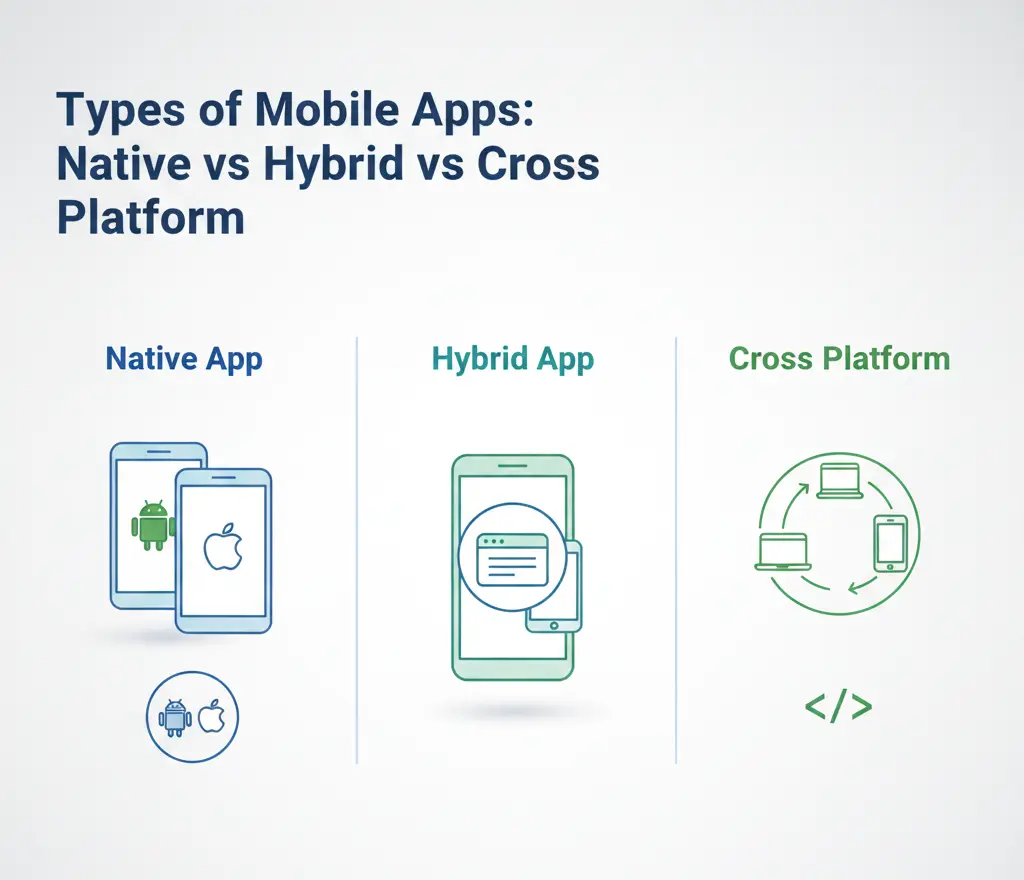
Most mobile application development projects fall into one of three broad approaches. Each has a distinct set of strengths and trade-offs that make it more or less suitable depending on the product’s requirements.
Native Development
Native apps are built specifically for a single platform, Android or iOS, using that platform’s own development tools and standards. Because the app is built to run within one environment, it can take full advantage of the platform’s capabilities, including hardware access, performance optimisations, and platform-specific interface conventions.
- Strengths: Highest performance, smoothest user experience, and unrestricted access to device hardware and platform features.
- Trade-offs: Building separately for each platform increases both cost and development time. Maintaining two separate codebases requires more ongoing resource.
- Best suited to: Products where performance and user experience quality are non-negotiable, and where the business is committed to long-term investment in the product.
Cross-Platform Development
Cross-platform apps are built using a single shared codebase that runs on both Android and iOS. Frameworks such as Flutter and React Native make this possible by providing tools that produce interfaces and functionality that closely resemble native behaviour without requiring duplicate builds for each platform.
- Strengths: Development moves faster, overall cost is lower than native, and a shared codebase means updates reach both platforms without doubling the effort.
- Trade-offs: Some advanced features or deep hardware integrations may still require platform-specific code. Very graphics-intensive applications may encounter performance limitations.
- Best suited to: Businesses that need to reach both Android and iOS users efficiently, without the full resource commitment of native development. This approach is well-suited to most commercial applications.
Hybrid Development
Hybrid apps are built using web technologies and packaged inside a mobile container that allows them to run on a device like a traditional app. They share a codebase across platforms and can be developed quickly and cost-effectively.
- Strengths: Fast to build, cost-effective for simple use cases, and accessible to teams with web development experience.
- Trade-offs: Performance and user experience are generally lower than native or cross-platform approaches, particularly for complex or interaction-heavy applications.
- Best suited to: Simple applications, early-stage prototypes, or situations where getting to market quickly and at low cost outweighs the need for a polished user experience.
Matching the Stack to Your Needs
Rather than searching for a single best option, the more useful question is which approach fits what your product actually needs at this stage. The following framework provides a starting point for that decision.
| Use Case | Recommended Stack |
|---|---|
| High-performance apps | Native |
| Fast MVP or quick launch | Flutter or React Native |
| Budget-focused projects | Cross-platform |
| Simple or basic apps | Hybrid |
These are starting points, not fixed rules. The right decision depends on the specific characteristics of your product, your team, and your business objectives. A capable development partner will work through these factors with you rather than defaulting to a preferred approach.
How to Choose the Right Stack for Your Product
Stack selection is ultimately a practical decision, not a technical one. The following questions help frame the choice in terms that are relevant to the business rather than to the engineering team alone.
- How complex is the application? Products with real-time features, intensive data processing, or complex user interactions place higher demands on performance. The stack needs to be capable of meeting those demands reliably.
- Who are the users and which platforms do they use? If the target audience is distributed across Android and iOS, cross-platform development avoids duplicating effort while still serving both groups effectively.
- How quickly does the product need to reach users? For early versions or MVPs, development speed is often the dominant priority. Cross-platform and hybrid approaches can compress timelines significantly compared to native.
- What is the available budget? Native development involves a higher upfront investment. Cross-platform approaches help manage early-stage costs without eliminating the option to invest more heavily later.
- What does growth look like? Stack decisions made today will shape what is possible in twelve or twenty-four months. Choosing a stack that can support the product’s realistic growth trajectory avoids costly rebuilds later.
Most experienced mobile application developers do not look for a perfect stack. They identify the approach that fits the current stage of the product and select tools that leave room to adapt as requirements evolve.
Conclusion
There is no single technology stack that is best for every mobile application. The right choice is determined by what the product needs to do, the stage the business is at, and the trade-offs that are acceptable given the current constraints.
Native development delivers the highest level of performance and user experience. Cross-platform development offers a practical and cost-effective path to reaching both major platforms without duplicating effort. Hybrid development provides a fast and accessible option for simpler use cases where speed to market is the primary concern.
What makes the most meaningful difference is not which stack is theoretically superior, but which one fits the product’s current goals and gives it the best foundation to grow from.
Sumanas Technologies works with businesses to evaluate stack options in the context of their specific product requirements, timelines, and growth plans. With development teams based in Madurai and Coimbatore, Sumanas brings the technical experience to make stack decisions that hold up over time, not just at launch.

Blogs
Related Posts

LET’S HAVE A TALK ABOUT our Products.
Need More Information or Want to Get in Touch?
We’re here to help! Whether you need detailed information or just want to chat, our team is ready to guide you through everything Sumanas has to offer. Reach out, and let’s start a conversation.
Enquire Now