

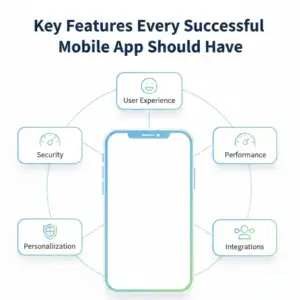
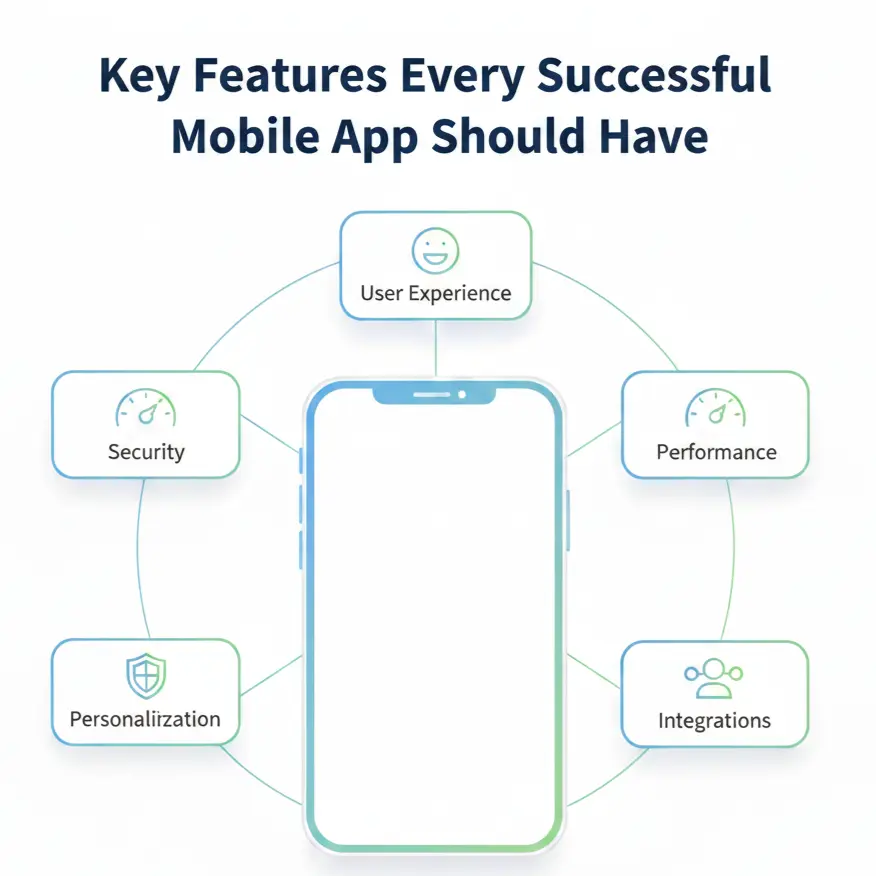
Key Features Every Successful Mobile App Should Have
Getting the Basics Right Matters More Than Adding More
Not every mobile app fails because of a flawed concept. In many cases, the gap between an app that retains users and one that does not comes down to whether the fundamentals were built correctly. Users today bring higher expectations to every app they open. Speed, simplicity, and a consistent experience are no longer differentiators. They are the baseline.
In mobile app development, success is rarely the result of packing in more features. It comes from getting the right ones in place and executing them well. This blog outlines the features that consistently make the most difference to how users experience and respond to a product.
User Experience: The First and Most Important Layer
What users respond to most immediately is the quality of the experience the app delivers. If users cannot quickly understand where to go or what to do next, they leave. The friction does not need to be significant to cause disengagement. A single confusing moment in the first session is often enough.
Good user experience is not about following design trends. It is about clarity, consistency, and removing every obstacle between the user and what they came to do.
- Clean and uncluttered interface: Users should be able to orient themselves immediately without needing to explore or guess.
- Intuitive navigation: Moving between sections should feel natural and require as few steps as the product allows.
- Consistent layout across screens: Visual and structural consistency reduces cognitive load and helps users build familiarity with the product quickly.
- Smooth onboarding for first-time users: The first session sets the tone for everything that follows. A well-designed onboarding experience increases the likelihood that users return.
Small improvements to the user experience often have a larger impact on retention than adding entirely new features. Experienced mobile app developers treat this layer as a priority because small improvements here consistently show up in retention numbers.
Performance and Reliability: What Keeps Users Engaged
A well-designed interface brings users in. Performance determines whether they stay. If an app feels slow, freezes unexpectedly, or crashes even once during a critical moment, users begin to lose confidence in it. Most will not wait for an update to resolve the issue.
In mobile application development, speed and stability are not optional extras. They are part of the product’s core promise to its users.
- Fast loading times: Users have a low tolerance for waiting. Screens that load slowly create frustration that accumulates across sessions.
- Smooth transitions between screens: Janky or slow transitions break the sense of flow and make the app feel less polished than it may actually be.
- Stability under normal and peak usage: Crashes and unexpected errors are among the most direct causes of app abandonment. The app must behave consistently regardless of usage conditions.
- Regular updates and maintenance: Performance does not stay constant after launch. Every OS release, new device launch, and spike in user activity brings fresh demands that require ongoing attention after launch.
Personalisation: Making the App Feel Relevant
Users do not all expect the same experience, and apps that adapt to individual behaviour tend to perform better over time. Personalisation does not need to be technically complex to be effective. Even small adjustments that make the app feel like it understands the user can have a meaningful impact on engagement and retention.
- Personalised content or recommendations: Surfacing content that is relevant to a specific user’s behaviour or preferences makes the app feel more useful on each visit.
- Contextual notifications: Notifications that are relevant and well-timed are engaged with. Notifications that are generic or excessive are ignored or lead to the app being uninstalled.
- User-specific settings and preferences: Allowing users to configure the app to their own needs gives them a sense of ownership over the experience.
Personalisation is an area where the industry is evolving rapidly, with data-driven and intelligent features becoming increasingly common. Even at a basic level, apps that remember and respond to user behaviour consistently outperform those that treat every session as a fresh start.
Security and Trust: A Non-Negotiable Foundation
As mobile apps handle increasing volumes of personal data, security has become a deciding factor in whether users adopt and continue using a product. Users may not always actively evaluate security, but they notice quickly when something feels wrong. A single data incident or a poorly handled permission request can permanently damage the trust that took considerable time to build.
In mobile application development, security is not a feature to be added once the product is otherwise complete. Security needs to be embedded into the architecture from day one, not retrofitted once the rest of the product is built.
- Secure authentication options: Supporting biometric login, multi-factor authentication, and secure session management protects users while reducing friction in the sign-in process.
- Data encryption and safe storage: User data must be encrypted both in transit and at rest. How data is stored is as important as how it is transmitted.
- Transparent privacy practices: Users should understand clearly what data the app collects, how it is used, and what controls they have over it.
- Protection against common vulnerabilities: Authentication weaknesses, insecure API connections, and data exposure risks must be identified and addressed before the app reaches users.
Accessibility and Reach: Building for More Users
An app that works well only under ideal conditions is an app that excludes a meaningful portion of its potential audience. Users switch between devices, use apps in varying network conditions, and have different physical needs. Designing for this range of contexts is not just good practice; it directly affects adoption and retention.
- Consistent experience across Android and iOS: Users on both platforms should receive an equivalent quality of experience, regardless of which device they use.
- Responsive design across screen sizes: Layouts need to reflow and scale gracefully across the full range of devices users bring to the app, without content breaking or controls becoming inaccessible.
- Basic accessibility support: Text sizing, contrast ratios, and screen reader compatibility extend the app’s usability to a wider range of users.
- Offline functionality where relevant: Core features that can function without a live connection reduce the app’s dependency on network conditions and improve the experience in lower-connectivity environments.
Integrations: Connecting to What Users Already Use
A well-built app does not try to replicate everything in isolation. It connects with the tools and services that users already rely on, reducing friction and making everyday actions faster and more convenient.
- Social login options: Allowing users to sign in with an existing account removes a barrier that causes a meaningful percentage of users to abandon sign-up.
- Secure payment gateways: In-app transactions need to be handled through trusted, compliant payment infrastructure. User confidence in this area directly affects conversion.
- Location-based features: Where relevant to the product, GPS and mapping integrations can significantly improve the relevance and utility of the experience.
- Third-party service connections: APIs that extend the app’s functionality through established external services add value without requiring everything to be built from scratch.
| Feature Type | Impact on Users |
|---|---|
| Social Login | Faster sign-up and reduced drop-off at registration |
| Payment Integration | Smoother transactions and higher purchase completion rates |
| Location Services | More contextually relevant content and features |
| APIs and Integrations | Improved overall convenience and reduced user effort |
How These Features Work Together
No single feature determines whether a mobile app succeeds. An app can have strong security but a frustrating user experience. It can be beautifully designed but perform poorly under load. Users notice the weakest point in the chain, and that is what shapes their overall perception of the product.
What consistently separates apps that retain users from those that do not is the degree to which these elements work together rather than in isolation.
- Good experience makes the app comfortable and easy to use from the first session.
- Strong performance keeps interactions smooth and builds confidence over time.
- Robust security creates the trust that encourages users to engage more deeply with the product.
- Relevant personalisation gives users a reason to return, because the product continues to feel useful and tailored to them.
Conclusion
A successful mobile app is not defined by a single standout feature. It is defined by the quality and coherence of the whole. Experience, performance, security, personalisation, and reach all need to reach a sufficient standard for the product to feel trustworthy and worth returning to.
Getting these fundamentals right early in the mobile app development process shapes how users respond to the product from the very first session, and how they continue to engage with it over time.
Sumanas Technologies builds mobile applications with these foundations in place from the start. With development teams based in Madurai and Coimbatore, Sumanas works with businesses to design and deliver products that are built around what users actually need, not just what initially seemed like a good idea.




Blogs
Related Posts

LET’S HAVE A TALK ABOUT our Products.
Need More Information or Want to Get in Touch?
We’re here to help! Whether you need detailed information or just want to chat, our team is ready to guide you through everything Sumanas has to offer. Reach out, and let’s start a conversation.
Enquire Now