

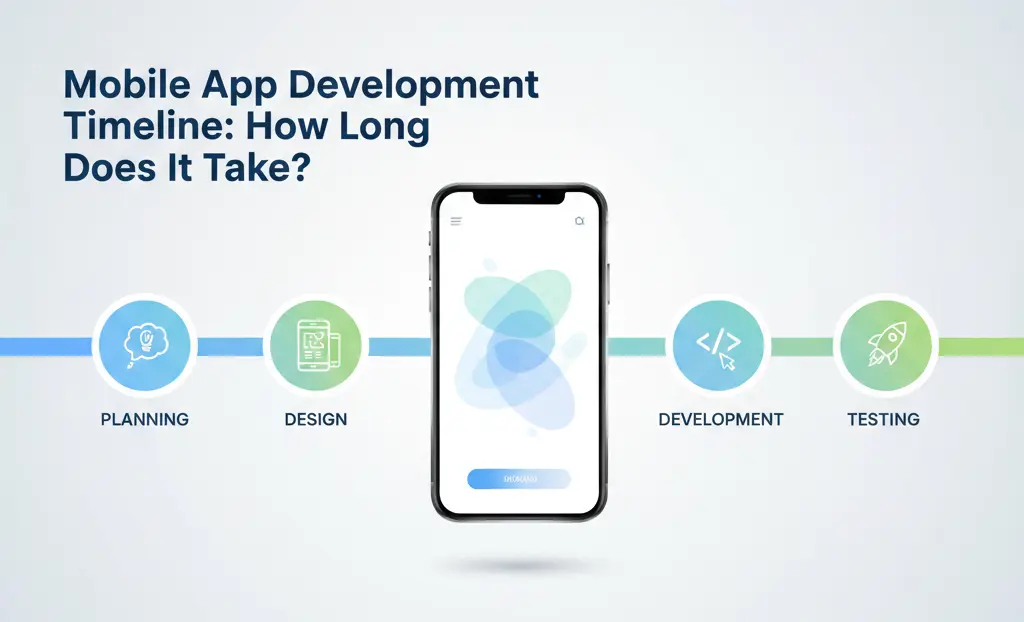
Mobile App Development Timeline: How Long Does It Take?
Why There Is No Single Answer
When will my app be ready? Understanding what drives the timeline is more useful than chasing a single number. Timelines in mobile development do not follow a fixed formula. Two apps that look similar on the surface can have very different development timelines behind them.
Features, complexity, platform choices, and decisions made along the way all have the potential to shift timelines significantly. Rather than working from a single number, it is more useful to understand how timelines are shaped and what actually influences them.
What a Realistic Timeline Looks Like
While there is no universal figure, most mobile app development projects fall into recognisable ranges based on scope and complexity.
- Simple apps with a focused feature set and minimal integrations tend to move through development relatively quickly.
- Mid-level apps covering multiple features, login systems, and external service connections take longer as each addition raises the overall build complexity.
- Complex apps with real-time functionality, advanced integrations, or multi-platform requirements can extend significantly beyond initial estimates.
In mobile application development, the more useful question is not how long it takes in general, but what specifically is being built and what decisions are shaping the scope.
How the Timeline Breaks Down by Stage
A mobile app development timeline is not a single block of time. The total duration is distributed across a sequence of stages, each carrying its own workload and depending on what came before it. Understanding how time is distributed across these stages gives a more accurate picture of the overall commitment involved.
| Stage | Typical Time Range |
|---|---|
| Planning | 1 to 3 weeks |
| Design | 2 to 4 weeks |
| Development | 2 to 6+ months |
| Testing | 2 to 6 weeks |
| Deployment | 1 to 2 weeks |
These ranges are indicative, not fixed. In faster-moving projects, some stages run in parallel rather than sequentially, which can compress the overall timeline. In more complex projects, each stage may take longer than the upper end of these ranges suggests.
What Each Stage Involves
- Planning: Ideas are clarified, scope is defined, and priorities are established. The quality of decisions made here directly affects how smoothly everything that follows runs.
- Design: User flows are mapped, wireframes are developed, and the interface is designed. The time required depends on the depth of the experience being designed.
- Development: The core build phase, where frontend and backend are constructed and connected. This is where the majority of the timeline is spent, and where complexity has the most direct impact on duration.
- Testing: Bugs, performance issues, and edge cases are identified and resolved across devices and usage scenarios. Rushing this stage consistently produces problems that are more expensive to fix post-launch.
- Deployment: The app is submitted for app store review and released. App store reviews follow their own schedule and can add days or weeks that no development team can fully account for in advance.
What Actually Affects the Timeline
Even with a clear plan in place, timelines are influenced by a range of factors that are not always visible at the outset. Understanding these helps set more accurate expectations from the start.
- App complexity: Features like real-time updates, payment processing, or data-heavy functionality each add meaningful time to the development phase.
- Number of features: More screens and more user flows mean more development, testing, and review time. Individual features may seem small, but they accumulate quickly across a full build.
- Platform choice: Building for both Android and iOS takes longer than targeting a single platform. Cross-platform development using frameworks like Flutter or React Native can reduce this gap without requiring entirely separate builds.
- Team experience: Developers with relevant experience in the domain and technology tend to move faster and require less rework, particularly during testing and integration phases.
- Third-party integrations: Connecting to external services such as payment gateways, mapping tools, or analytics platforms adds time that is often underestimated at the planning stage.
- Scope changes mid-project: Modifying or adding features once development is underway is one of the most reliable causes of timeline extension. Changes that seem minor at the decision point frequently ripple through multiple parts of the build.
In mobile application development, timelines rarely extend because of a single large problem. They extend because of a series of smaller decisions, each of which moves the completion date by a small amount, until the cumulative effect becomes significant.
How to Keep the Timeline on Track
Timeline management is not primarily about moving faster. It is about making better decisions earlier so that less time is lost to rework, clarification, and course correction later.
- Start with an MVP: Building the core version first allows the product to reach users quickly while keeping scope contained. Additional features can be added once the foundation is validated.
- Lock in platform and technology decisions early: Locking in these choices before the first line of code is written prevents the kind of mid-project disruption that pushes timelines out by weeks.
- Run stages in parallel where possible: Backend development, UI design, and frontend work do not always need to proceed sequentially. Overlapping where the dependencies allow it can meaningfully reduce the total timeline.
- Avoid late-stage scope additions: Changes introduced late in the development cycle consistently cause more disruption than their apparent size suggests. Holding scope firm through the build phase protects the timeline.
- Maintain frequent review cycles: Regular checkpoints allow issues to be identified and addressed before they compound. Projects with clear, frequent communication between business and development teams consistently move faster than those without it.
A Real-World Perspective
In practice, projects with clearly defined scope and stable requirements tend to complete closer to their initial estimates. Projects where requirements evolve frequently, or where decisions are deferred rather than made, consistently run longer than planned.
The most effective way to protect a timeline is not to move faster during development. It is to invest more thoroughly in the planning and scoping stages so that what gets built does not need to be revisited.
- A well-defined plan reduces time lost to clarification: Teams that know exactly what they are building spend less time asking questions and more time building.
- Fewer scope changes mean fewer cascading delays: Each change mid-build affects not just the feature being changed but the parts of the system connected to it.
- Strong coordination accelerates progress: When business stakeholders and the development team are aligned and responsive, decisions get made faster and the project moves with less friction.
Conclusion
There is no fixed timeframe for building a mobile app. The duration depends on what is being built, how clearly it is defined, and how well the project is managed from start to finish. A product developed with a focused scope and disciplined decision-making can move faster than most initial estimates suggest. A product where requirements remain unclear or continue to shift will take longer, regardless of how capable the development team is.
The objective is not speed alone. It is delivering something that works well, holds up under real usage, and gives the business a reliable foundation to build on.
Sumanas Technologies works with businesses to plan and execute mobile app development projects with clear timelines and structured processes. With teams based in Madurai and Coimbatore, Sumanas brings the experience to scope projects accurately, manage them efficiently, and deliver outcomes that match what was agreed from the start.

Blogs
Related Posts

LET’S HAVE A TALK ABOUT our Products.
Need More Information or Want to Get in Touch?
We’re here to help! Whether you need detailed information or just want to chat, our team is ready to guide you through everything Sumanas has to offer. Reach out, and let’s start a conversation.
Enquire Now